

close
Choose Your Site
Global
Social Media


Views: 124 Author: Site Editor Publish Time: 2026-09-26 Origin: Site


Traditional open-field farming faces an existential crisis today. Climate volatility makes predictable agricultural yields almost impossible. You can no longer rely on historical weather patterns to secure seasonal profits. Consequently, transitioning toward Controlled Environment Agriculture (CEA) represents an urgent necessity. Most low-margin farming relies heavily on temporary plastic or polycarbonate structures. However, enterprise-scale operations realize these materials fall short over time. They are increasingly shifting toward permanent glass structures to secure their future.
We must objectively evaluate these advanced commercial facilities. Does the significant initial capital expenditure align against your specific agricultural production goals? We will explore the critical material sciences, operational realities, and yield-optimizing technologies driving this massive industry shift. You will learn exactly when investing in high-grade glass makes strategic sense. By the end of this evaluation, you will understand how modern glazing technologies integrate effortlessly alongside complex automation to create hyper-efficient growing environments.
Lifespan & ROI: Glass structures offer a 40+ year operational lifespan without the light degradation (yellowing) inherent in plastics.
Yield Optimization: High light transmission and diffuse glass technologies directly correlate with increased crop yields and uniformity.
High Upfront CapEx: Requires significant initial investment and heavy-duty structural foundations, suited only for high-value crops or long-term enterprise planning.
Sustainability Edge: Aligns with modern ESG goals via recyclability, longevity, and integration with advanced climate control systems.
Growers face unpredictable weather patterns globally. Strict resource management mandates a totally new approach. The industry frequently calls this the "growing more using less" mandate. You must produce higher yields using less water, fewer fertilizers, and a smaller land footprint. Enclosed, hyper-controlled environments provide the only viable solution to this modern challenge.
Temporary hoop houses offer attractive short-term savings. They utilize cheap polyethylene film for rapid deployment. However, they fail utterly to deliver strict climate consistency. High-value crops demand absolute environmental precision daily. Vine crops, medicinal plants, and multi-tier vertical farming operations cannot tolerate sudden temperature fluctuations. A brief unexpected frost or an aggressive summer heatwave destroys profit margins instantly.
Therefore, environmental predictability supersedes initial material savings entirely. You can calculate exactly when a permanent structure makes financial sense. Target return-on-investment timelines often dictate adoption rates for commercial producers. Evaluate your local natural light levels carefully before building. Assess your specific crop margin requirements honestly. A premium medicinal crop easily justifies higher capital expenditures. If you plan to operate for decades, permanent facilities become highly attractive. They protect your agricultural assets comprehensively against erratic external climates.
You must evaluate the specific physical properties of modern glazing materials. High-quality standard glass maximizes Photosynthetically Active Radiation (PAR) naturally. Low-iron glass variations push this physical performance even further. They frequently deliver over 90% total light transmission. Plants require maximum PAR exposure for optimal daily photosynthesis. Every single percentage point of available light directly equals potential yield increases. You leave money on the table when you block beneficial sunlight.
Diffuse glass technology transforms how natural light enters the canopy. Manufacturers treat or mechanically etch the exterior glass surfaces. This manufacturing process scatters incoming direct sunlight effectively. Scattered light prevents damaging upper canopy leaf burn. It reaches deep into the lower plant leaves highly efficiently. This ensures highly uniform crop growth across massive commercial acreage. Uniformity makes automated harvesting significantly easier.
You need an Agricultural Glass Greenhouse built specifically for rigorous environments. Do not fall for generic marketing claims regarding material indestructibility. Safety and physical durability require strict engineering standards. Tempered safety glass represents an absolute non-negotiable requirement. Look for compliance certificates matching recognized EN 12150 standards. The glass must withstand immense structural stress constantly. Heavy winter snow loads and extreme wind impacts destroy weaker materials rapidly. Buyers must verify exact impact ratings prior to finalizing any purchase. Real-world structural engineering always trumps theoretical sales promises.
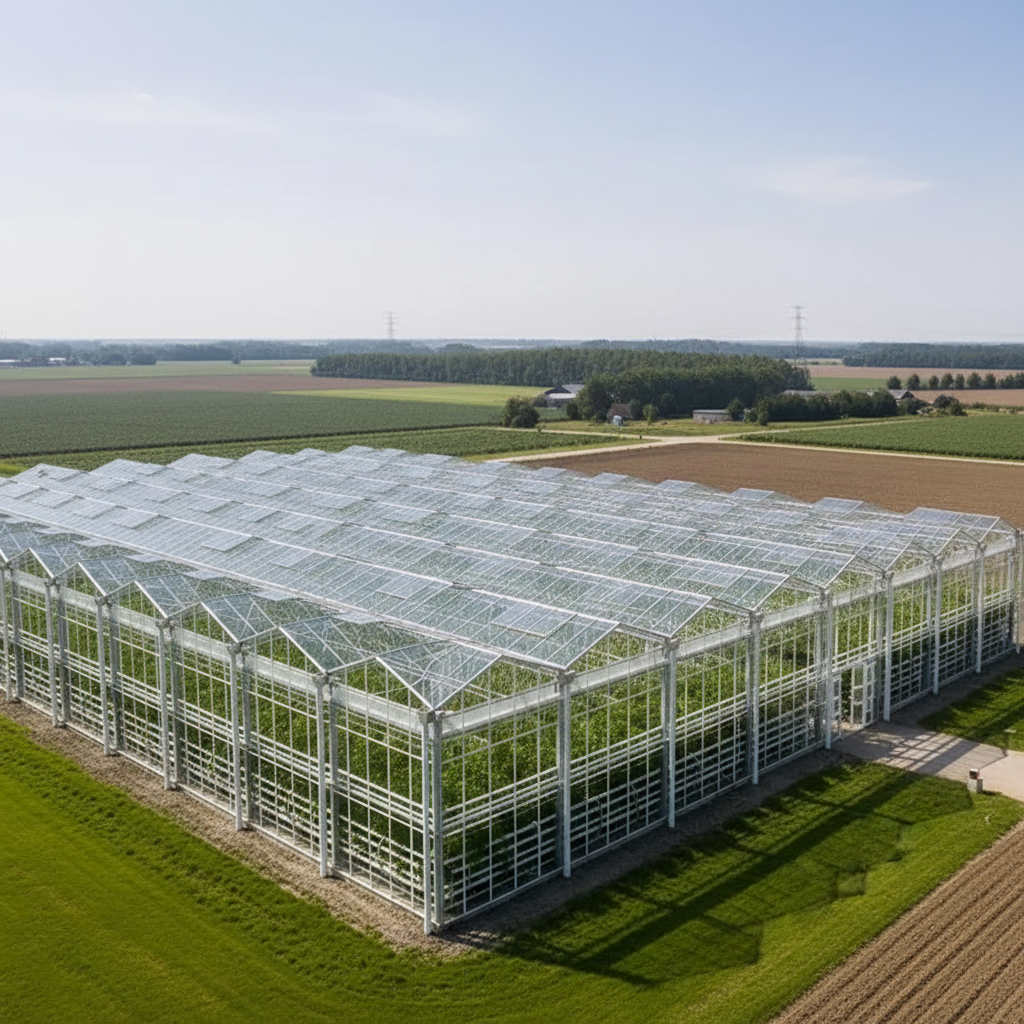
Commercial agriculture typically relies on three main solution categories. Polyethylene film provides cheap, temporary coverage. Polycarbonate rigid panels offer mid-range durability. Glass delivers permanent, high-performance protection. You must compare their long-term operational lifespans objectively to make a smart decision.
Light degradation represents a massive hidden expense for growers. Evidence-based reality shows polycarbonate degrades steadily under UV exposure. It loses up to 1% of its light transmission annually. Sunlight causes inevitable yellowing across plastic surfaces over time. Over a single decade, your crop receives significantly less solar energy. Glass remains optically clear indefinitely. It maintains peak transmission rates decades after initial installation.
Thermal efficiency requires an honest and balanced assessment. Standard single-pane glass possesses a lower R-value than twin-wall polycarbonate. Polycarbonate inherently traps air between layers for better natural insulation. You must mitigate this thermal disadvantage actively. Commercial growers introduce double-glazing configurations in extremely cold regions. They also deploy automated internal thermal screens. These advanced systems trap heat effectively during freezing cold nights.
Lifecycle calculations strongly favor permanent structures. Polycarbonate panels demand a 10-to-15-year replacement cycle constantly. Labor costs compound repeatedly during these frequent material replacements. Conversely, glass offers a reliable 40-to-50-year operational lifecycle. You build the facility once. It serves multiple generations of agricultural production effortlessly.
Material Type | Estimated Lifespan | Light Degradation (Annual) | Insulation Quality (Base) |
|---|---|---|---|
Polyethylene Film | 3 - 5 Years | High (Rapid Yellowing) | Very Poor |
Polycarbonate Panels | 10 - 15 Years | ~1% Loss Per Year | Good (Twin-wall) |
Tempered Glass | 40 - 50+ Years | 0% (Remains Clear) | Moderate (Requires Screens) |
Deployment involves serious physical and logistical challenges. Glass weighs significantly more than simple plastic films. This heavy weight necessitates robust poured concrete foundations. You cannot anchor a permanent facility using simple dirt posts. Robust steel or heavy-duty aluminum framing must support the panels rigidly. This engineering reality increases site preparation complexity tremendously.
Heating costs represent the primary vulnerability in severe cold climates. We must address this elephant in the room transparently. A permanent structure requires advanced technological integrations. You must install motorized energy curtains to retain expensive heat. HVAC automation systems control interior climate variables precisely. Builders must prevent thermal bridging across the outer metal framework. Poorly insulated aluminum frames bleed expensive heat into the freezing winter air constantly.
Permanent structures face distinct regulatory hurdles locally. They often trigger stricter municipal zoning laws. Building codes treat them as permanent commercial facilities rather than agricultural sheds. Temporary plastic structures frequently bypass these stringent municipal regulations entirely. Tax assessors may revalue your agricultural land based on these permanent structural improvements.
Site readiness demands rigorous physical evaluation. Consider these specific assessment steps before starting construction:
Soil bearing capacity: Engineers must verify the ground can support massive concrete footings safely without sinking.
Local load codes: You must calculate historical wind and snow data to determine necessary structural frame thickness.
Electrical grid capacity: Heavy agricultural automation requires substantial three-phase electrical power connections.
Water rights: Massive enclosed facilities need guaranteed water access for complex daily irrigation arrays.
Modern agriculture integrates robotics rapidly. Rigid glass structures provide the ideal physical baseline for heavy automation. Robotic harvesting arms require millimeter-perfect structural stability to function. Complex overhead irrigation booms introduce immense dynamic weight constantly. A swaying plastic hoop house cannot support these advanced technologies safely. The structural rigidity of a Glass Greenhouse handles these mechanical stresses easily.
Smart glazing technologies are entering commercial reality right now. We see the verified emergence of semi-transparent solar glass panels. These specialized panels generate electrical power locally for the facility. Crucially, they do this without starving growing crops of essential light. Dynamic tinting technologies also offer unprecedented active climate control. The glass automatically darkens during peak summer heat waves. It blocks excessive infrared radiation actively to protect delicate canopies.
Vertical farming facilities face unique light-distribution challenges indoors. Multi-tier setups create massive internal shadow zones quickly. Custom-tempered diffuse glass addresses this specific problem brilliantly. The textured material bends natural light deep into the facility aisles. It complements artificial overhead LED arrays beautifully. This hybrid lighting approach reduces total electricity consumption while maximizing actual plant growth potential.
We must summarize the objective realities clearly. An enterprise-grade glass facility requires the highest initial capital investment. However, it delivers unmatched light transmission properties consistently. Structural longevity guarantees a highly stable production environment for decades. Long-term yield predictability justifies the initial financial barrier completely for serious operators.
Decision-makers should shortlist solutions carefully. Audit your specific 10-year business plan first. Analyze local climate data and extreme weather probabilities thoroughly. Consider your exact crop value and target profit margins before committing heavily to construction.
You should request a site-specific structural audit immediately. Consult specialized greenhouse engineering teams regarding your specific geographic constraints. They can model precise lifecycle metrics for your unique operation. Establish your true foundation requirements today to ensure profitable agricultural yields tomorrow.
A: Costs typically range between $25 and $50 per square foot for the base structure alone. However, poured concrete foundations, advanced climate control systems, and automated thermal screens dictate the final price. A fully automated enterprise facility often exceeds these baseline estimates based on specific geographical engineering requirements.
A: Modern commercial facilities utilize 4mm tempered safety glass rather than standard annealed glass. This specific tempering process increases impact resistance significantly. Most high-grade agricultural panels meet strict industry impact-testing standards. They withstand severe hail events safely without shattering into dangerous shards.
A: Yes, standard single-pane glass possesses a lower thermal resistance (R-value) than twin-wall polycarbonate. It transfers heat faster. Commercial growers easily offset this physical disadvantage by installing automated internal thermal screens. These specialized energy curtains deploy at night, trapping vital heat near the crop canopy efficiently.


